
IMSI

TiO2 nanotube arrays decorated with platinum group metal nanoparticles for electrocatalysis applications

About project

Project title:

TiO2 nanotube arrays decorated with platinum group metal nanoparticles for electrocatalysis applications

Acronym:

/

Financier:

Bilateral cooperation project between the Republic of Serbia and the Federal Republic of Germany

Budget:

~3000 EUR

Project duration:

2020-2021

Project coordinator:

University of Belgrade – Institute for Multidisciplinary Research

Friedrich-Alexander-University of Erlangen-Nuremberg, Department of Materials Science, WW4-LKO

Project partners:

University of Belgrade – Faculty of Technology and Metallurgy

University of Belgrade – Faculty of Physics

Project leader for IMSI:

Dr Uroš Lačnjevac,
Senior Research Associate

Project website:

/

Social media:

/

Location:

/

Keywords:

Hydrogen evolution reaction, galvanic displacement, composite electrodes, electrocatalyst supports.
Senior Research Associate  

Telephone:

E-Mail:

Website:

Linkage to the Global Sustainable Development Goals (SDGs)

Project description

The increasing global energy and environmental concerns caused by the overconsumption of traditional fossil fuels and the progressive exhaustion of their reserves in the Earth’s crust have directed the worldwide research efforts towards developing clean and sustainable energy production and conversion devices. Hydrogen is considered the most promising clean fuel alternative due to its high theoretical energy density and zero greenhouse gasses emission. The operation of non-polluting low-temperature fuel cells generating electricity requires the utilization of high-purity hydrogen fuel, which can be produced in a sustainable manner from water electrolysis with the assistance of solar or wind renewable energy sources. For achieving high efficiency of these electrochemistry-based hydrogen consumption and production technologies, high-performance and long-lifetime electrocatalytic materials need to be deployed. The platinum group metals (PGMs: Ru, Rh, Pd, Os, Ir and Pt) are indispensable components of state-of-the-art electrocatalysts owing to their excellent activity and corrosion resistance. However, they are scarce and expensive, so in order to make the large-scale employment of PGM-based electrodes economically viable, it is of paramount importance to further reduce the PGM loading and simultaneously maintain or even raise the activity.
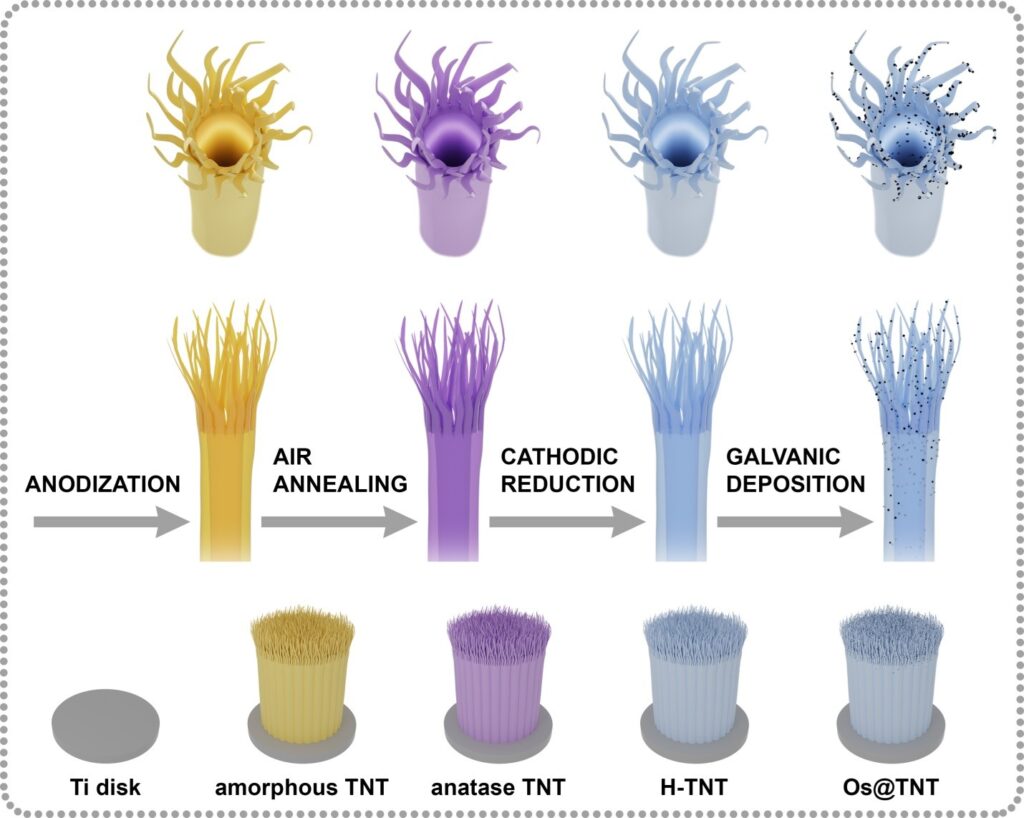
To tackle this challenging task, this project aims to develop novel, advanced composite materials based on anodically formed, self-ordered TiO2 nanotube (TNT) arrays as interactive supporting structures for a series of PGM-containing nanocatalysts, namely Os, Rh and Ir. We will apply our original, recently reported galvanic displacement method for the in-situ decoration of TNT walls with PGM nanoparticles. The obtained PGM@TNT composites will be tested as cathode and anode materials for electrocatalytic reactions proceeding in water electrolysers and fuel cells. The investigations will be focused on understanding the influence of synthesis parameters on the resulting microstructural properties, noble metal loading and electrocatalytic activity to rationally design PGM@TNT composite catalysts with optimal performance. The Serbian side will be in charge of the synthesis and electrochemical characterization of the Os, Rh and Ir@TNT composites, while the German side will have the central role in their structural and chemical composition analysis.
The general objectives of the proposed bilateral project are strengthening the established partnership, transfer of knowledge, use of facilities unavailable in own laboratories and exchange of researchers, samples and data. Apart from the research outcomes, the plan is to intensify the scientific relations between the Serbian and German group and to promote the mobility of researchers as well as their personal and professional growth through joint activities.

Results

  1. Journal of Materials Chemistry A 8 (2020) 22773–22790.
    https://doi.org/10.1039/D0TA07492F.
  2. ACS Applied Materials and Interfaces 15(26) (2023) 31459–31469.
    https://doi.org/10.1021/acsami.3c04498

Project team

  • Project leader (PI):
    • Dr Uroš Lačnjevac, University of Belgrade – Institute for Multidisciplinary Research
    • Prof. dr Patrik Schmuki, Friedrich-Alexander-University of Erlangen-Nuremberg, Department of Materials Science, WW4-LKO
  • Team:
    • University of Belgrade – Institute for Multidisciplinary Research: Dr Nevenka Elezović
    • Friedrich-Alexander-University of Erlangen-Nuremberg, Department of Materials Science, WW4-LKO: Dr Anca Mazare, Helga Hildebrand, Imgon Hwang, Shanshan Qin

    • University of Belgrade – Faculty of Technology and Metallurgy: Dr Mila Krstajić Pajić, Daniel Mijailović
    • University of Belgrade – Faculty of Physics: Prof. dr Rastko Vasilić
Scroll to Top